
What if everyday memory changes aren’t something you have to accept without understanding? If you’re over 40 and wondering about a forgotten name or misplaced item, you’re not alone. A free memory support guide can offer a clear place to begin. It’s also fair to ask what the guide covers and how to use its information.
Memory and neuroscience can feel confusing, especially when supplement claims and dosage figures come wrapped in technical language. You deserve plain explanations, not promises of a quick fix. An educational guide can help you explore the subject, but it can’t diagnose a health concern or replace medical care.
The NeuroRevivers guide covers neuroplasticity, hippocampal changes, neuroinflammation, nutrition, cortisol, and ingredients such as Lion’s Mane, Bacopa Monnieri, and Omega-3s. It also discusses research and clinical dosing, with dosage information presented as a topic to understand rather than personal advice. The guide is free, requires no credit card, and is designed to make these subjects easier to understand. By the end, you’ll have a clearer sense of whether it’s a useful educational next step for you.
Key Takeaways
- Everyday memory lapses don’t automatically mean disease. Treat them as a reason to learn more, not as a reason to blame yourself.
- The free memory support guide offers adults over 40 an educational starting point for exploring natural memory-support topics.
- Lifestyle tips, practical memory aids, and natural-support education serve different purposes. Choose the resource that fits your question.
- When reviewing supplement information, identify the claim, look at the evidence, consider safety context, and note what remains uncertain.
- Treat dosage figures as information to interpret, not personal instructions or a substitute for medical care.
Free Memory Support Guide: Start With What You Need
Forgetting why you walked into a room or searching for a familiar name can be frustrating. It may leave you wondering whether there’s something you should understand or whether it’s an ordinary lapse. One moment of forgetfulness doesn’t, by itself, tell you what’s happening. Good information can help you explore the subject without turning every small slip into a reason to worry.
The free memory support guide is an educational resource for adults over 40 who want to understand natural approaches to memory support. It brings neuroscience and nutrition topics together in plain English, giving you an overview before you decide what questions or next steps matter to you.
A useful overview does more than list disconnected tips or ingredient claims. This guide introduces several factors discussed in the context of memory and focus, helping you see how the topics relate. It’s an invitation to learn, not a promise that a particular approach will restore memory or work the same way for everyone.
Who is this memory support guide for?
It’s for adults over 40 who are curious about memory, concentration, or how the brain works. You might have noticed occasional lapses, or you may simply want to learn before making choices. You don’t need a diagnosis or a specific concern to read it. The guide offers accessible background on natural memory-support topics for people who want to understand the landscape before looking more closely at particular claims.
What makes a free guide worth reading?
A coherent overview can help you connect concepts and see where questions remain, instead of relying on a striking claim taken out of context. For a broad look at approaches and influences, Memory Improvement Strategies also surveys topics such as cognitive training, diet, stress management, and exercise. The NeuroRevivers guide focuses on neuroscience, nutrition, and supplement information. It’s free and requires no credit card.
Use the guide as a learning aid. Note unfamiliar terms, separate general information from claims that need evidence, and write down questions you may want to discuss with a qualified health professional. That’s different from receiving a personal recommendation: the guide doesn’t assess your health, diagnose a cause, prescribe treatment, or determine what is right for you.
Educational material can make a complicated topic easier to approach, but it can’t account for your health history, medications, or individual circumstances. If a memory change worries you or affects daily life, the guide isn’t a substitute for medical care. Its value is a clearer overview and a more informed starting point, without assuming the worst.
What the Free Memory Support Guide Covers, From Brain Science to Nutrition
The guide brings together subjects often scattered across technical articles and supplement claims. Its aim is to give adults over 40 a plain-English map of the topics, not to reduce memory to one cause or promise one solution.
The guide covers neuroplasticity, hippocampal shrinkage, neuroinflammation, nutritional deficiency, cortisol overload, Lion’s Mane, Bacopa Monnieri, Omega-3s, and clinical dosing. This range moves from brain processes to nutrition and supplement information, giving you a clearer sense of what the guide explores.
These terms describe different kinds of questions. Some concern brain structures or processes; others relate to nutrients or ingredients discussed in memory-support contexts. Seeing them together can help you identify what you want to understand without assuming that any one topic explains your own experience.
How the guide connects brain processes and memory
The guide discusses neuroplasticity, the brain’s capacity to adapt, alongside hippocampal changes, including shrinkage. It also covers neuroinflammation and cortisol overload as topics related to memory support. Their inclusion doesn’t mean they are proven causes of a reader’s forgetfulness. The guide provides background to explore, not an assessment of what is happening in an individual brain.
This distinction keeps the science in perspective. A topic can be relevant to understanding brain health without serving as a diagnosis or a complete explanation for everyday lapses. As you read, consider whether each concept is presented as background, a research question, or a claim about an intervention. These are different levels of certainty and shouldn’t be blurred together.
How nutrition and supplement information is presented
On the nutrition side, the guide covers nutritional deficiency and discusses Omega-3s, Lion’s Mane, and Bacopa Monnieri. It also addresses clinical dosing. This section is educational: NeuroRevivers provides information, not supplements or personalized dosage recommendations.
A dosage figure alone doesn’t tell you which population was studied, what preparation was used, how long it was taken, or what safety considerations apply. Evidence can differ across studies and products. When you encounter a dosage statement, look for its supporting source and the context around it. Don’t treat the number as personal instructions.
As you explore the free memory support guide, jot down unfamiliar terms and questions about the evidence behind a claim. That turns a broad overview into a more useful reading experience without asking you to draw medical conclusions. To explore the guide’s topics in one place, review the memory-support guide.
How This Free Guide Differs From Memory Tips and Memory-Aid Resources
Memory resources can answer very different questions. A lifestyle article may suggest habits to support general wellbeing, while a reminder tool can help you keep track of appointments. The free memory support guide takes another approach: it organizes natural-support education for adults over 40, bringing biological and nutritional topics into one learning resource. Each has a role, and none needs to replace the others.
| Resource | Main purpose | Who it may help |
|---|---|---|
| General lifestyle tips | Offer everyday ideas around habits such as sleep, activity, and organization. | People looking for practical routines or broad health guidance. |
| Practical memory aids | Support daily tasks with reminders, calendars, notes, or memory books. | People who want help organizing information or communication. |
| Natural-support education | Explain brain, nutrition, and supplement-related topics in an organized overview. | Adults over 40 who want context before exploring options. |
This guide offers organized natural-support education, while lifestyle tips and memory aids focus on habits and day-to-day tasks. The difference is about purpose, not quality. General recommendations from reputable health organizations can provide useful guidance, and practical tools can make everyday routines easier. The guide provides a separate kind of context rather than competing with those resources.
A protocol overview is not the same as a list of memory tricks
A reminder on your phone may help you remember an appointment; an overview of natural-support topics helps you understand ideas related to brain processes and nutrition. The guide is educational, not a personalized protocol. It doesn’t assess your circumstances or promise a particular result, and it shouldn’t be treated as superior to established health guidance. Use it to build understanding, then consider which questions need reliable evidence or professional input.
A personal learning resource is not a caregiver memory-aid handbook
Memory books and reminder cards are practical tools often designed to support caregivers and people managing specific memory challenges. They can help with communication, routines, and keeping useful information close at hand. This guide has a different audience: adults over 40 exploring memory-support topics for themselves. If your question involves dementia or a diagnosed condition, guidance from qualified health resources is more appropriate than relying on a general educational overview.
You can use these resources side by side. Try a calendar or written checklist for an immediate organizational need, consult broad health guidance for everyday habits, and use the guide to understand its natural-support subject matter. If memory changes are concerning or interfere with daily life, an educational resource can’t evaluate their cause. Professional assessment and practical supports serve different needs, and one doesn’t cancel out the value of the other.
How to Read Supplement Evidence and Dosage Information Responsibly
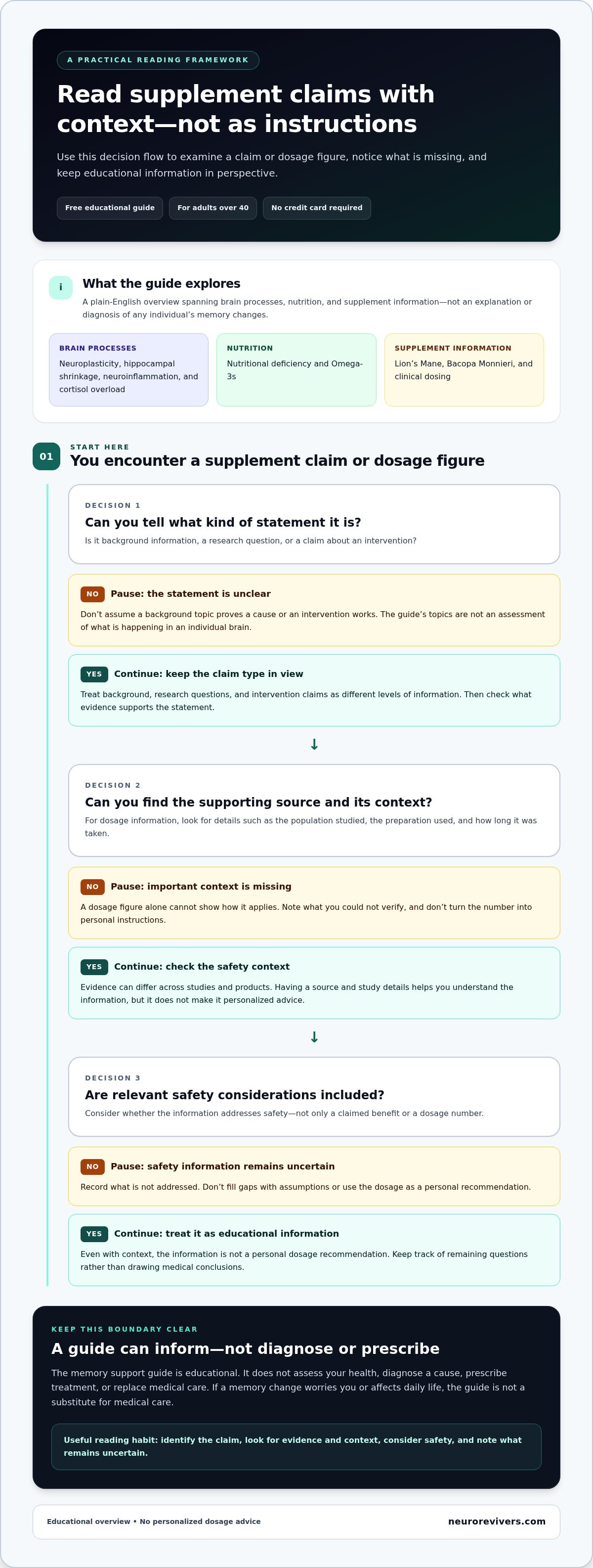
Supplement claims can sound certain even when the evidence behind them is limited or specific. A dosage figure may look precise, but precision alone doesn’t show that it applies to you. Use a simple framework: identify the claim, examine the evidence, check the safety context, and note what remains uncertain. This helps you separate information worth exploring from conclusions that go beyond what the evidence supports.
- Identify the claim. Is it about memory, focus, or another outcome? Notice whether the wording promises a result or describes a topic being studied.
- Examine the evidence. Look for the source behind the statement and what it actually examined.
- Check the safety context. Consider whether the information addresses possible interactions, health conditions, or other relevant cautions.
- Note uncertainty. Record what the evidence doesn’t establish, as well as what it does.
What to look for when a guide discusses research
Keep a study’s findings separate from the interpretation attached to them. A result in a particular group or under specific study conditions doesn’t automatically prove that an ingredient will produce the same outcome for everyone. Check whether the evidence involves people, the ingredient named in the claim, and the outcome being discussed.
Also watch for missing context. Is the statement about a single study, or does it reflect a wider body of evidence? Does the conclusion match the study’s actual focus? If the source is hard to trace or the wording sounds broader than the evidence described, treat the claim cautiously. Uncertainty isn’t a failure of the guide or the reader. It’s useful information.
Why dosage details need personal health context
Educational dosage information is not an individualized recommendation. A dosage figure depends on what was studied and how the information is being applied. Medicines, health conditions, and individual circumstances may affect supplement decisions, so don’t treat a number in an article or guide as an instruction to start, stop, or change anything.
The free memory support guide discusses clinical dosing as an educational topic. It isn’t a personal assessment, and this section doesn’t prescribe an amount. Before acting on supplement information, discuss it with a qualified clinician, especially if you take medicines, have a health condition, or have concerns about memory changes. A clinician can consider your circumstances in a way general educational material cannot.
To make your reading practical, note the claim, its source, the population and outcome described, and any safety questions that remain. Bring those questions to a qualified professional rather than relying on a dosage figure alone. For a plain-English overview of the guide’s supplement and dosing topics, explore the free memory-support guide.
Get the Free Memory Support Guide and Choose Your Next Step
If you’re over 40 and want a clearer, plain-English introduction to memory support, this guide brings several connected topics into one place. It covers brain science, nutrition, and supplement information, including neuroplasticity, hippocampal shrinkage, neuroinflammation, nutritional deficiency, cortisol overload, Lion’s Mane, Bacopa Monnieri, Omega-3s, and clinical dosing.
The aim is to help you understand what the guide discusses and give you context for further questions. It doesn’t determine why you’re experiencing a memory change, recommend a personal supplement plan, or promise a particular outcome. Think of it as a learning resource, not a shortcut to a diagnosis or a guaranteed solution.
What to expect before downloading
The free memory support guide is designed for adults over 40 who want to explore natural memory-support topics without getting lost in technical language. You’ll find an overview spanning brain processes, nutrition, named ingredients, and clinical dosing. The guide is free and requires no credit card. Its purpose is to make these subjects easier to consider, not to tell you what to take or predict what will happen if you follow a particular approach.
As you read, pause over the topics that matter most to you. Perhaps you want to understand a neuroscience term, make sense of how nutrition is discussed, or see what questions dosage information raises. Note those questions rather than treating a general statement as a personal instruction. That distinction helps keep educational material useful and in perspective.
When to take a concern beyond an educational guide
A guide can explain topics, but it can’t assess symptoms, diagnose a condition, or replace medical care. If memory changes persist, worsen, or concern you, consider seeking professional evaluation. You don’t need to decide on your own what a change means before asking for help. A qualified health professional can consider your circumstances and advise on appropriate next steps.
That’s not a reason to assume the worst. It’s a practical way to have an individual concern assessed rather than asking general reading material to answer a personal health question. Use the guide to become familiar with its subject areas, and bring medical questions to a qualified professional.
If this overview fits what you’re looking for, download the free memory support guide and explore the topics at your own pace. It’s a calm place to begin learning, without a promise that one approach suits everyone or a suggestion that education replaces medical care.
Make Your Next Step a Clearer One
You don’t need to solve every question about memory today. A useful next step can be small: learn what a claim means, notice what you still want to know, and avoid turning general information into a personal diagnosis. Curiosity can replace guesswork without requiring you to make a decision before you’re ready.
The free memory support guide offers adults over 40 plain-English education on neuroscience, nutrition, and supplement topics. It’s free, requires no credit card, and is intended to inform, not replace medical care or promise a particular result. Use it at your own pace. If a concern persists or grows, bring your questions to a qualified health professional.
Get the free memory support guide and take a calm, informed step toward understanding the subject. Learn first, ask questions, and choose what comes next with care.
Frequently Asked Questions
Is the NeuroRevivers memory support guide really free?
Yes. The NeuroRevivers memory support guide is free and requires no credit card. It’s an educational resource for adults over 40 who want to learn about memory support in plain English. It isn’t a supplement offer or a clinical consultation, and it doesn’t provide personal health advice. Use it to understand the topics it covers, then decide what questions you’d like to explore further.
Can a memory support guide diagnose the cause of forgetfulness?
No. An educational guide can’t assess your symptoms or determine why you’re forgetting things. Memory changes can have different explanations, and reading about possible factors won’t identify which, if any, applies to you. If changes persist, worsen, happen suddenly, or concern you, seek advice from a qualified medical professional. A guide may help you prepare questions, but it can’t replace an individual evaluation.
Does the guide include exact Lion’s Mane or Bacopa doses?
The guide covers Lion’s Mane, Bacopa Monnieri, and clinical dosing, but don’t assume a dosage amount applies to you. Interpret any specific figure in context, including the evidence and safety information behind it. Dosage information is educational, not a personal recommendation. If you’re considering a supplement, discuss the decision with a qualified clinician who can consider your health circumstances.
Are natural memory supplements proven to restore memory?
There isn’t one answer that applies to every ingredient or person. Evidence depends on the ingredient studied, the population, the research methods, and the outcome measured. A guide discussing an ingredient doesn’t establish that it restores memory or guarantees a benefit. Look at what a study actually found rather than relying on a broad promotional claim, and talk with a qualified health professional about how the evidence relates to your circumstances.
Can I use supplement information in the guide if I take medication?
The guide can’t assess whether a supplement is appropriate alongside your medication. Supplements may raise safety questions involving medicines or health conditions, and the details depend on your situation. Before starting, stopping, or changing a supplement, speak with a qualified clinician or pharmacist. If you’re preparing for that conversation, bring the product or ingredient information you’re considering and a current list of your medicines.
What should I do if my memory changes suddenly or keeps getting worse?
Contact a qualified healthcare professional promptly for advice, especially if a change is sudden, worsening, or worrying to you. A downloadable guide can’t assess your symptoms, determine their cause, or judge how urgent they are. You don’t need to work out what the change means on your own. Share what you’ve noticed and when it began so a professional can advise you on appropriate next steps.