
What if a useful natural memory support protocol is less about finding one “brain booster” and more about understanding the whole picture? If you’ve heard conflicting claims about supplements or wondered whether memory changes mean you’re doing something wrong, you’re not alone. These changes can feel unsettling, but they aren’t a personal failing and shouldn’t be dismissed as inevitable.
A thoughtful approach connects everyday foundations, such as sleep, movement, and nutrition, with questions about factors that may affect brain health. It also treats supplement claims carefully: promising language isn’t the same as strong evidence, and no guide can diagnose the cause of memory changes. New or worsening concerns are worth discussing with a healthcare professional.
Here, you’ll learn what a natural support approach can cover and how to assess the evidence behind its recommendations. We’ll look at lifestyle habits, nutritional considerations, and supplement claims, then explore how NeuroRevivers’ free, plain-English guide for adults over 40 organizes topics such as neuroplasticity, inflammation, and commonly discussed ingredients. The goal is to help you ask clearer questions and identify a practical next step, not to promise results or replace medical care.
Key Takeaways
- A natural memory support protocol is coordinated educational guidance, not a single supplement or a guaranteed result.
- Learn how topics such as neuroplasticity, hippocampal changes, stress, and nutrition fit into a careful, whole-picture approach.
- Compare memory-support ingredients by the evidence, populations studied, limitations, and safety questions, rather than by bold claims.
- Use a practical checklist to review your goals and track changes in context without treating self-observation as a diagnosis.
- Explore a free, plain-English NeuroRevivers guide for adults over 40, covering neuroscience and commonly discussed ingredients.
What Is a Natural Memory Support Protocol, and What Should It Include?
Forgetting why you walked into a room, misplacing your glasses, or struggling to recall a name can feel unsettling. These moments deserve attention, but they don’t automatically mean decline is inevitable or that you’ve failed to look after yourself. Memory involves several processes, not a single mental switch. The Memory overview offers a basic introduction to how it can be understood.
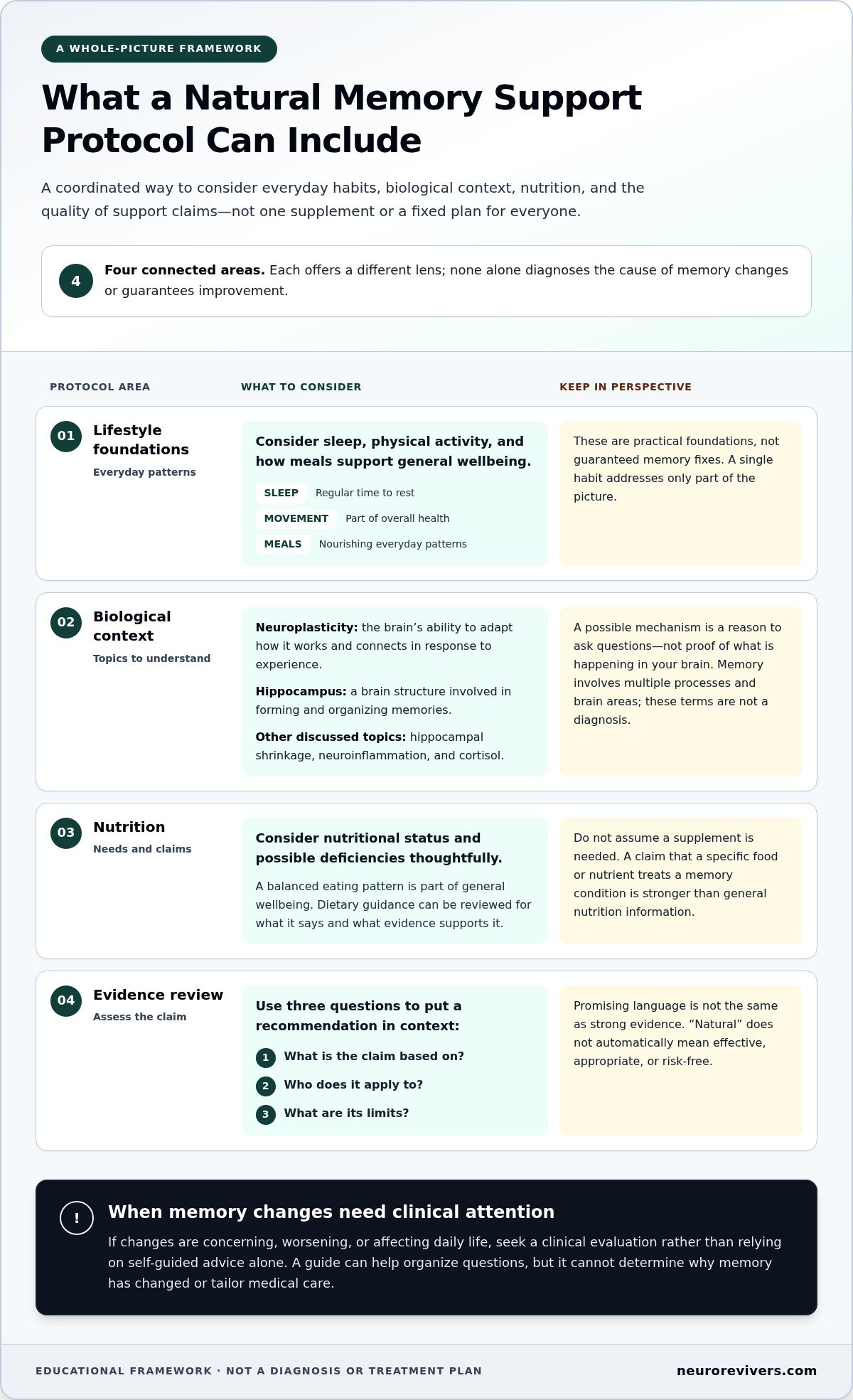
A natural memory support protocol is coordinated educational guidance for considering everyday habits, relevant biological context, nutrition, and the quality of claims about possible supports. It isn’t one food, supplement, or fixed plan for everyone. Nor is it a diagnosis, treatment, or promise of improved memory. Its value is in helping you see how different areas fit together and identify questions worth exploring.
How a protocol differs from a single memory tip
A single tip can be useful, but it addresses only one part of the picture. A framework connects the parts: sleep and movement are lifestyle foundations; stress, hippocampal changes, and nutritional status provide biological context; and evidence review helps distinguish a plausible suggestion from a confident-sounding claim. You don’t need to do everything at once. Start by understanding the rationale behind each component and whether it makes sense for your circumstances.
For example, you might review your sleep routine, note whether a new memory concern appeared alongside a change in daily habits, and examine the evidence behind a nutrition claim. That’s more considered than assuming one supplement or “brain food” can address every concern. A structured approach also leaves room to set aside suggestions that aren’t suitable or relevant to you.
- Lifestyle foundations: Consider everyday patterns such as sleep, physical activity, and how meals support general wellbeing.
- Biological context: Treat neuroplasticity, hippocampal shrinkage, neuroinflammation, and cortisol as topics to understand, not proof of a cause or a diagnosis.
- Nutrition: Consider nutritional status and possible deficiencies thoughtfully, rather than assuming a supplement is needed.
- Evidence review: Ask what a claim is based on, who it applies to, and what its limits are.
What a natural approach can and cannot promise
The goal is informed support, not guaranteed improvement or disease prevention. “Natural” doesn’t automatically mean effective, appropriate, or risk-free. A guide can explain ideas and help you organize questions, but it can’t determine why your memory has changed or tailor medical care to you.
If changes are concerning, worsening, or affecting daily life, seek a clinical evaluation rather than relying on self-guided advice alone. That isn’t a reason for panic or self-blame. It’s a practical way to understand what may be happening and consider next steps with appropriate support.
The Foundations Behind Natural Memory Support After 40
A useful framework looks beyond a single habit or ingredient. It considers how daily routines and biological topics may relate to brain health, while separating general education from explanations of one person’s symptoms. That distinction matters: a possible mechanism is a reason to ask questions, not proof of what is happening in your brain.
What neuroplasticity and the hippocampus contribute to the conversation
Neuroplasticity is the brain’s ability to adapt how it works and connects in response to experience. This plain-English definition reflects the concept discussed in neuroscience resources from the U.S. National Library of Medicine. Adaptability is real, but it doesn’t mean the brain can change without limits or that a particular routine will reverse age-related changes.
The hippocampus is a brain structure involved in forming and organizing memories. It’s relevant to the conversation, but it isn’t a complete explanation for every lapse or change. Memory involves multiple processes and brain areas, so a mention of hippocampal shrinkage in an educational resource should prompt careful understanding, not self-diagnosis. A plain-language overview of how memory works can help put the term in context.
Why inflammation, cortisol, and nutrition need careful framing
Neuroinflammation, cortisol, and nutritional status also need careful interpretation. They may appear in discussions of brain health, but reading about them cannot establish that inflammation, stress hormones, or a nutrient deficiency is causing your memory concerns. A biological explanation can sound persuasive while still being too broad to apply to an individual.
Nutrition deserves the same measured approach. A balanced eating pattern is part of general wellbeing; a claim that a specific food or nutrient treats a memory condition is a different, much stronger claim. When considering dietary guidance, look at what it says, what evidence supports it, and whether it distinguishes general information from medical advice.
These topics sit alongside the everyday foundations of a support framework. Sleep gives the brain regular time to rest; movement and stress-management practices can be considered as parts of overall health; nourishing meals provide context for discussing nutritional needs. None should be presented as a guaranteed memory fix. They are practical areas to review, not a test of willpower or a substitute for clinical care.
- Connect the levels: Consider daily habits alongside biological questions, rather than treating one as the whole answer.
- Separate possibility from proof: A mechanism may be worth learning about without explaining an individual’s symptoms.
- Keep claims in bounds: General wellness guidance is not the same as treating or preventing a condition.
For adults over 40 who want these subjects gathered in plain English, NeuroRevivers’ free memory-support guide covers neuroplasticity, hippocampal changes, neuroinflammation, cortisol, and nutritional status. It’s an educational resource, not a diagnosis or personalized medical advice. If memory changes are concerning or progressing, discuss them with a healthcare professional rather than relying on a natural memory support protocol alone.
How to Assess Natural Memory Support Ingredients and Evidence
A familiar ingredient name or a confident testimonial doesn’t show whether a memory claim is reliable. Check what researchers studied, who took part, what outcome was measured, and whether the result supports the claim being made. Evidence can range from early laboratory research to human clinical studies and established medical guidance. These levels aren’t interchangeable, and evidence for one ingredient doesn’t prove that a complete natural memory support protocol works as a whole.
How to read claims about Lion’s Mane, Bacopa, and omega-3s
Lion’s Mane, Bacopa monnieri, and omega-3s are topics in the NeuroRevivers educational guide, not guaranteed solutions. For each ingredient, look for the study type and population, then ask whether the measured outcome was memory, another aspect of cognition, or something else. A result in one group or on one measure can’t automatically be applied to every reader or generalized to an entire protocol.
| Ingredient | Type of evidence to examine | Studied population | Limitations to consider | Safety questions |
|---|---|---|---|---|
| Lion’s Mane | Is the claim based on laboratory, animal, or human clinical research? | Who participated, and do their characteristics match the people the claim addresses? | How many studies are relevant, and what memory outcome did they measure? | Could it be appropriate alongside a person’s health conditions or medicines? |
| Bacopa monnieri | Look for the design and duration of human studies, if cited. | Were participants healthy, older, or experiencing specific concerns? | Do the findings apply to the ingredient and preparation being discussed? | What cautions or potential interactions should be discussed with a clinician? |
| Omega-3s | Check whether evidence concerns dietary intake or a supplement. | Identify participants’ age, health context, and baseline nutrition if reported. | Which omega-3 and outcome were studied? Don’t generalize across all claims. | Consider medicines, health conditions, and personal circumstances with a clinician. |
This table is a reading guide, not an evidence verdict on these ingredients. Preliminary findings can help shape research questions; clinical research tests effects in people; established medical guidance reflects a different level of evaluation. Evidence about an ingredient also doesn’t prove that combining it with lifestyle steps creates a proven protocol.
What clinical dosing information does, and does not, tell you
A dose used in a study describes that study, not what you personally should take. Research protocols don’t account for every person’s health history, medicines, or needs. Don’t treat a number in an article or guide as individualized instructions, and don’t assume one dose suits everyone. For personal supplement or medication questions, speak with a qualified clinician.
NeuroRevivers’ free, plain-English guide for adults over 40 discusses these ingredients and clinical dosing as educational topics. It can help you frame questions, not make a treatment decision. Use it alongside careful evidence review, and raise personal safety questions with your clinician.
A Practical Checklist for Using a Memory-Support Framework Safely
A framework is most useful when it helps you make thoughtful choices, not when it pressures you to follow every suggestion. Use this sequence to assess whether advice is clear, relevant, and safe enough to discuss or consider.
- Set a specific goal. Identify what you want to understand or support, such as building a steadier sleep routine or reviewing a memory claim. Keep the goal realistic and avoid treating it as a promise of results.
- Check the evidence. Look for human research, what outcome was measured, who participated, and what limitations the authors describe. Be cautious if a claim leaps from an early finding to a broad promise about a whole protocol.
- Separate habits from supplements. You may be able to review everyday routines, such as sleep or movement, as general wellness choices. Supplements require additional care because health conditions, medicines, allergies, and individual needs can affect whether they’re appropriate.
- Plan practical follow-through. Choose a manageable step, consider how you’ll keep it consistent, and decide what would prompt you to pause or seek advice. Avoid making several changes at once if you want to understand what may be connected to a change you notice.
Questions to ask before following any protocol
Does the guidance cite human research and explain its limits? Does it distinguish educational information from research findings and treatment? Does it address safety questions relevant to existing conditions, medicines, allergies, and personal circumstances? If those answers are missing, treat the recommendation as incomplete, not as a personalized instruction.
A brief record can add context without turning you into your own diagnostician. Note what you noticed, when it happened, and relevant circumstances such as changes in routine, sleep, or medication. Look for patterns rather than drawing conclusions from one difficult day. These notes can help you describe your concern clearly if you decide to seek care.
When to seek help rather than self-manage
Occasional everyday lapses can happen, but persistent, worsening, or disruptive changes deserve clinical attention. Sudden confusion or an abrupt change is different and warrants prompt medical attention. Don’t assume memory concerns are simply due to age, stress, or nutrition; a clinician can assess them in context.
Gradual everyday lapses may be worth observing, but persistent, worsening, disruptive, or sudden changes call for clinical attention. This is a guide for deciding when to ask for help, not a way to diagnose the cause. If symptoms feel concerning, prioritize evaluation over self-tracking or supplement experiments.
For a plain-English educational resource to help organize questions about memory support, explore the free NeuroRevivers memory-support guide for adults over 40. It requires no credit card and isn’t a substitute for personal medical advice.
Explore the NeuroRevivers Natural Memory Support Guide
Once you know what to look for in a memory-support framework, a plain-English overview can help bring unfamiliar topics into focus. The NeuroRevivers educational guide is designed for adults over 40. It’s free and requires no credit card. Use it to explore key ideas and organize questions, not as a promise that any one approach will change memory.
What readers will find in the guide
The guide brings together brain biology, factors that may be relevant to everyday wellbeing, and ingredient topics. Rather than treating them as a ready-made prescription, use this structure to see how different questions fit within a broader natural memory support protocol.
- Brain biology: Neuroplasticity and hippocampal shrinkage.
- Related factors: Neuroinflammation, cortisol, and nutritional deficiency.
- Ingredient and dosing topics: Lion’s Mane, Bacopa monnieri, omega-3s, and clinical dosing information.
These subjects call for different kinds of interpretation. A discussion of a brain process isn’t a diagnosis; an ingredient topic isn’t proof of benefit; and dosing information from clinical research isn’t an instruction tailored to you. The guide can help you recognize the questions behind these topics, then consider what evidence and personal context matter before acting on a claim.
A simple next step for readers who want a clearer framework
Use the guide as an educational starting point. As you read, note which topics you want to understand better and write down questions about evidence, safety, or how a concern relates to your health. If memory changes are worrying or affecting daily life, those questions can help you have a more focused conversation with a healthcare professional.
The guide doesn’t diagnose a condition, recommend a personalized plan, or replace clinical advice or treatment. Its role is to make complex subjects easier to examine, so you can approach claims with more clarity and avoid confusing general information with care intended for you.
If you’re ready for a structured overview, explore the free memory-support guide.
Take Your Next Step With Clarity
You don’t need to overhaul your routine or act on every memory-related claim you encounter. Start with one useful question: what would help you make a more informed choice? A natural memory support protocol is most useful when it gives you a framework for exploring options thoughtfully, not pressure to follow a rigid plan or expect a guaranteed result.
If you’d like a structured place to continue learning, NeuroRevivers offers a free, plain-English memory-support guide for adults over 40. It requires no credit card and is designed to inform, not replace personal medical advice or treatment. Use it to clarify which topics matter to you and, if needed, prepare questions for a healthcare professional.
Explore the free memory-support guide and take your next step at your own pace. Clearer information can make the path ahead feel more manageable.
Frequently Asked Questions
Can a natural memory support protocol improve memory after 40?
It may help you make informed choices about habits and nutrition, but it can’t promise better memory. Researchers examine these areas, yet results differ across people and approaches. For example, improving a disrupted sleep routine may be a reasonable wellbeing goal, but it doesn’t establish why someone is forgetting things. If memory concerns persist or worsen, arrange clinical evaluation rather than relying on a protocol alone.
Is a natural memory support protocol the same as treatment for memory loss?
No. It offers general information about lifestyle, nutrition, and related research; it can’t identify the cause of memory changes or treat a condition. If a concern is new, persistent, or interfering with familiar tasks, discuss it with a qualified healthcare professional. An educational guide may help you note unfamiliar terms or prepare questions, but it can’t assess symptoms or determine what care is appropriate.
How much Lion’s Mane or Bacopa should I take for memory?
There isn’t one amount that can safely be recommended for everyone from a general article. Study methods and supplement products may differ, and personal health factors matter. Don’t use a research dose as your own instruction or increase an amount because you haven’t noticed a change. If you’re considering Lion’s Mane or Bacopa, take the product information and your questions to a qualified healthcare professional before starting.
Can I combine memory-support supplements with prescription medication?
Don’t assume a supplement is safe to combine with a prescription. Possible interactions depend on the specific products and your health circumstances. Before starting or changing a supplement, show the full label to your healthcare professional or pharmacist, including its ingredients and serving directions. Keep taking prescribed medicine as directed unless the clinician who manages it advises otherwise. An online protocol can’t assess the safety of your personal combination.
How long does a natural memory support protocol take to work?
There’s no reliable timeline that applies to everyone, so be cautious of claims promising results by a set date. Research may examine different approaches over different periods, and that doesn’t predict an individual response. If you’re trying a general habit change, keep a simple note of what changed and when. Avoid judging the effect from one unusually good or difficult day, and discuss ongoing concerns with a clinician.
What should I do if my memory changes suddenly or keeps getting worse?
Seek medical advice rather than assuming the change is normal aging or something a supplement can address. Sudden confusion or an abrupt change calls for prompt medical attention. For ongoing difficulties, note when you first noticed them and give a concrete example of how they affect daily activities, such as following a familiar routine. Share those details with a healthcare professional; an educational resource can’t evaluate symptoms.
