
What if the best first step for memory support isn’t adding another tip, but deciding what to try, what to track, and when to ask for help? If advice feels scattered or a lapse has left you worried, you’re not alone. A step-by-step memory support guide can turn an overwhelming list into a practical plan, without promising a quick fix or asking you to blame yourself.
This article will help you build a realistic sequence of actions, assess claims, and keep useful notes on memory changes. You’ll learn how to choose manageable habits and distinguish occasional forgetfulness from problems that interfere with everyday life. If memory concerns affect familiar tasks or daily routines, professional evaluation matters. A plan can help you prepare for that conversation, not replace it.
NeuroRevivers’ free educational memory-support guide explains neuroscience in plain English. Here, we’ll focus on turning information into steady, safe steps you can maintain, while keeping expectations realistic and evidence in view.
Key Takeaways
- Use a step-by-step memory support guide to turn broad advice into a manageable sequence: define a goal, review credible guidance, choose one action, and observe.
- Keep expectations realistic: a memory-support routine can’t diagnose dementia or replace professional care.
- Notice whether changes persist or interfere with familiar daily tasks, and seek professional evaluation when they do.
- Track the action you tried, the context, and how practical it felt, then adjust without self-blame.
- Explore NeuroRevivers’ free, plain-English guide for further learning about brain science and nutrition-related topics.
Step-by-Step Memory Support: Start With the Concern You Want to Address
Forgetting a name or losing track of a task can feel unsettling. But one lapse, by itself, doesn’t explain why it happened or what it means. Stress, distractions, changes in routine, and health factors can all affect how easily we recall information. Rather than label yourself, start by describing what you’ve noticed.
This article is educational, not diagnosis or treatment, and no routine can promise better memory. Think of a step-by-step memory support guide as a way to organize questions and choose manageable actions, not as a test of your brain. The National Institute on Aging advises discussing changes that affect everyday life with a healthcare professional.
Choose a specific memory concern to guide your first steps
Start with one situation you want to understand or manage more confidently. Perhaps you’ve been losing track of tasks during a busy afternoon, or names seem harder to recall in conversation. When it happens, note what was going on, how often you’ve noticed it, and whether it gets in the way of something you usually do.
Keep the record factual, not diagnostic. Include relevant context, such as a disrupted routine or a particularly demanding day. A simple baseline gives you clearer language for describing what’s changed over time, and helps keep one frustrating moment from becoming the whole story.
Know when a memory concern deserves professional attention
Occasional forgetfulness can happen. A pattern that persists, worsens, or disrupts familiar activities is different and merits a conversation with a qualified healthcare professional. Examples include repeatedly struggling with tasks you’ve managed for years, getting lost in a familiar place, or memory changes that affect everyday responsibilities. These signs don’t prove a particular condition, but they are worth assessing.
A personal support plan can organize your observations, but only a healthcare professional can assess what persistent memory changes may mean. The National Institute on Aging recommends discussing concerns that interfere with daily life and reviewing medicines as part of an evaluation. Bring your notes if you have them, but don’t delay seeking advice to build a longer record.
Sudden confusion or an abrupt change is not the same as a gradual concern. Seek prompt medical attention, especially if the person seems acutely disoriented or cannot manage their immediate safety. If the change is severe or there may be an emergency, contact local emergency services.
Once you’ve named the concern, choose a practical next step without expecting a guaranteed result. For broader background, the overview of memory improvement techniques describes approaches and factors related to memory. Use general reading to form questions, not to diagnose yourself or replace professional advice. The goal is clarity: what you noticed, when it happens, and whether it affects daily life.
Build a Step-by-Step Memory Support Plan You Can Actually Follow
A long list of habits can make it hard to know where to begin. A useful step-by-step memory support guide takes you from broad information to one reasonable next action. Keep the plan flexible: it should fit your day and any health guidance you already follow, not become another source of pressure.
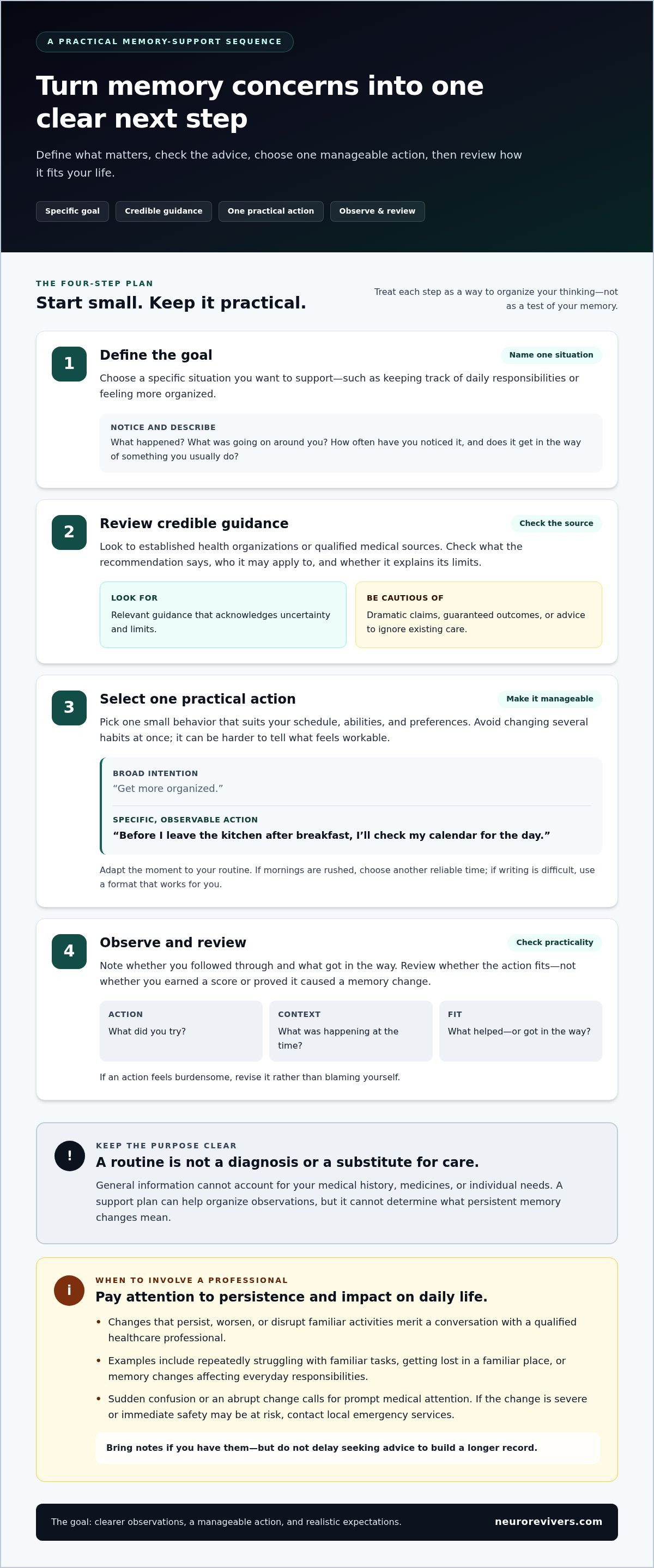
Use this sequence to turn an idea into something practical:
- Define the goal. Choose a specific situation you want to support, such as keeping track of daily responsibilities or feeling more organized. A clear aim makes it easier to judge whether an action suits your needs.
- Review credible guidance. Look for information from established health organizations or qualified medical sources. Check what a recommendation actually says, who it may apply to, and whether it acknowledges limits. Be cautious of dramatic claims, guaranteed outcomes, or advice that urges you to ignore your existing care.
- Select one practical action. Choose a small behavior that feels manageable with your schedule, abilities, and preferences. It might involve adjusting a routine or creating a reminder system. Avoid changing several habits at once, which makes it harder to tell what feels workable.
- Observe and review. Note whether you followed through and what got in the way. This is a check on practicality, not a score for your memory or proof that the action caused a change.
Turn broad advice into one small, observable action
“Get more organized” is a broad intention. “Before I leave the kitchen after breakfast, I’ll check my calendar for the day” is a specific behavior tied to a moment and context. Adapt the details to your routine. If mornings are rushed, choose another reliable time; if writing is difficult, use a format that works for you.
Begin with one change and give yourself room to see whether it fits. Small steps can make consistency easier, but they don’t guarantee a memory outcome. If the action feels burdensome, revise it rather than blaming yourself.
Use evidence and safety as filters before adopting advice
Before trying a recommendation, ask what evidence supports it, whether the source explains uncertainty, and whether the advice is relevant to your situation. General educational information can help you understand a topic, but it can’t account for your medical history, medicines, or individual needs. That distinction matters especially for supplements and dosage information.
Population-level research can inform a conversation, but it isn’t an individual prescription. Talk with a qualified healthcare professional before making personal decisions about supplements or changing health guidance. NeuroRevivers’ free memory-support guide offers plain-English learning about neuroscience and nutrition-related research. Use it as an educational starting point, not personalized medical advice.
With a goal, a credible source, one manageable action, and a simple review, you have a plan you can adapt instead of a pile of competing tips. For further plain-English learning, explore the free memory-support guide.
Memory Support or Medical Concern? Set Realistic Expectations
A supportive routine and a medical assessment serve different purposes. A routine can help you organize learning and everyday actions; an assessment evaluates changes in thinking and memory. Following a checklist cannot tell you whether you have dementia, and a habit should never be treated as proof that a health concern is resolved.
Patterns matter more than a single forgotten name or misplaced item. Notice whether something is becoming more frequent, whether it affects familiar tasks, and whether the change appeared gradually or suddenly. These details can help you choose an appropriate next step, but they can’t establish a cause on their own.
What a self-guided memory-support plan can and cannot do
A plan can help you explore trustworthy information, choose a manageable action, and keep track of whether it fits your life. It isn’t a treatment or a diagnostic tool, and individual experiences vary. No routine can guarantee sharper memory or prevent, reverse, or rule out disease. Keep existing care plans and professional advice in view as you consider general educational suggestions.
Recognize changes that should not be handled with a checklist alone
Changes that worsen or interfere with daily activities deserve attention beyond self-guided support. The National Institute on Aging advises discussing memory problems that affect everyday life with a healthcare professional. Sudden confusion or an abrupt change is different from a gradual concern and needs prompt medical attention. The NHS also advises seeking urgent help for sudden confusion.
If memory changes are worsening or disrupting daily life, arrange a professional evaluation; if confusion begins suddenly, seek urgent medical help. That’s a reason to get support, not a diagnosis. Don’t wait for a routine or a log to provide an answer.
Everyday lapses: An occasional slip, such as briefly forgetting a name or why you entered a room, without a continuing pattern of disruption. Note it if useful, but don’t treat one event as a test result.
Persistent functional changes: Increasing difficulty with familiar tasks, repeated questions, or changes that interfere with daily responsibilities. Discuss the pattern with a healthcare professional rather than relying on a self-guided plan alone.
Sudden or acute changes: New confusion or an abrupt shift in awareness or thinking. Seek prompt medical attention; sudden confusion can have causes that need timely assessment.
This comparison is a guide for choosing what to do next, not a screening checklist. A step-by-step memory support guide can help organize questions and everyday actions, while professional evaluation addresses concerns about what a change may mean. Keep the two roles separate, and let the effect on daily life guide whether it’s time to seek help.
Put Your Memory Support Steps Into Practice and Review Them
A plan becomes useful when you can see how it fits your real life. Tracking doesn’t need to be a test or a streak to maintain. Treat it as a simple feedback loop: choose one action, note whether you tried it, notice what helped or got in the way, then adjust. The aim is a practical routine, not a score that judges your memory.
Try this repeatable cycle:
- Choose one action. Keep the step small enough to fit your schedule and abilities.
- Record what happened. Note whether you did it and the context, such as a change in plans or an interruption.
- Review the fit. Ask whether the action was manageable and worthwhile, not whether it proves your memory improved.
- Adjust without blame. Keep, simplify, move, or replace the step based on what you learned.
Consistency and feasibility tell you whether the action belongs in your routine. If you notice a perceived memory change, record it neutrally. A log can show what you observed alongside what you tried, but it can’t prove that one caused the other or establish clinical improvement.
Track the routine without turning it into a performance test
Use a calendar, notebook, or notes app, whichever feels easiest. Keep each entry brief: the action, whether you tried it, the context, and how practical it felt. For example, you might note that a planned reminder was easy to use on an ordinary day but was missed during a schedule change. That detail helps you understand the routine, not grade yourself.
Avoid rigid streaks and memory quizzes. Missing a day isn’t failure, and a self-made score can’t determine what’s happening medically. Look for useful information about the action and its circumstances instead.
Review, adjust, and keep support practical
Choose a recurring moment to check your notes, such as the end of the week. Ask: Did this fit my day? What made it easier or harder? Is it still useful? If the step creates stress or no longer suits your circumstances, make it simpler or choose a different one. A practical plan can change as life changes.
If memory concerns persist, worsen, or begin to affect daily tasks, bring clear notes to a qualified healthcare professional. Describe what you noticed, when it happens, how it has changed, and how it affects everyday life. Share the routine you tried, but don’t use your log to diagnose yourself or delay seeking care. It’s a record to support a conversation, not a verdict.
A step-by-step memory support guide is most useful when it helps you turn information into steps you can review calmly. NeuroRevivers’ free educational guide explains brain science and nutrition-related topics in plain English, giving you material to organize further learning. Explore the free memory-support guide as an educational resource, not a personal prescription or a promise of results.
Use the NeuroRevivers Memory Support Guide as Your Next Learning Step
You now have a way to name a concern, choose one practical action, and review how it fits your life. For more context, NeuroRevivers’ free memory-support guide offers another educational step. Written in plain English for adults over 40, it makes brain science and nutrition-related topics easier to understand without requiring you to sort through unfamiliar terminology alone.
What readers can explore in the free memory-support guide
The guide covers several topics that may appear in memory-support discussions. These are subjects to learn about, not promised ways to improve memory or explanations of what’s causing an individual concern.
- Brain science: Learn about neuroplasticity, hippocampal shrinkage, neuroinflammation, nutritional deficiency, and cortisol overload.
- Nutrition-related topics: Explore educational information about Lion’s Mane, Bacopa Monnieri, and Omega-3s.
- Research and dosing: Read about research and clinical dosing discussed in relation to some nutrition topics.
This information can help you understand terms and identify questions for further learning. It isn’t an individualized recommendation. Dosage information should not be treated as a prescription for you, and the guide doesn’t replace advice from a qualified healthcare professional. Personal decisions about supplements can depend on individual circumstances, including existing health guidance and medicines.
Continue learning with a clear, low-pressure next step
A resource is most useful when you can take it at your own pace. As you read, note which topics you want to understand better and separate general research from decisions that need professional input. You don’t have to adopt every suggestion or change your routine all at once. Keep your practical plan grounded in what feels manageable, and use educational material to support questions rather than make a diagnosis.
If accessible explanations would help you organize your next steps, access the free memory-support guide. It requires no credit card. Consider it a learning resource, not medical diagnosis, treatment, or a promise of sharper memory.
Keep the boundary clear: persistent or worsening memory concerns deserve discussion with a qualified healthcare professional. Sudden confusion or an abrupt change calls for prompt medical attention. A guide can help you learn, but it can’t assess what a change means for you.
Choose One Clear Next Step
You don’t need to solve every memory question today. Choose a step that brings more clarity: keep learning at a comfortable pace, and seek qualified care if a concern persists or changes. A step-by-step memory support guide is most valuable when it supports thoughtful decisions, not pressure for a perfect routine or guaranteed results.
For adults over 40 who want an accessible place to continue exploring, NeuroRevivers’ free educational guide explains neuroscience and memory-support topics in plain English. It requires no credit card and is intended to support learning, not replace personal medical advice.
Get the free NeuroRevivers memory-support guide and take the next step when you’re ready. Small, informed choices can make the path ahead feel more manageable.
Frequently Asked Questions
Is occasional forgetfulness always a sign of dementia?
No. An isolated lapse, such as briefly blanking on a name, can’t establish dementia, but it shouldn’t be used to rule out a health concern either. Pay attention to whether forgetfulness becomes more frequent, progresses, or interferes with ordinary activities, such as following a familiar recipe or managing appointments. General information can help you describe what you notice, but only a qualified healthcare professional can assess your individual situation.
Can memory-support habits replace a medical evaluation?
No. Habits and a step-by-step memory support guide can offer general education, but they can’t diagnose or treat a medical condition. Don’t wait to see whether a new routine works if changes persist, worsen, or affect daily life. Tell a healthcare professional what you’ve noticed, when it happens, and how it affects you. Sudden or markedly different symptoms call for prompt medical attention, not self-assessment first.
How long does it take to notice a change from a memory-support routine?
There’s no universal timeline, and no routine can guarantee a noticeable memory change. Sleep, stress, health, and day-to-day demands may influence how you feel, so a short-term impression doesn’t prove that a particular habit caused an effect. Start by asking whether the action is realistic to keep up with. If concerns continue or worsen, arrange a professional conversation rather than waiting for the routine to work.
What should I do if memory problems suddenly get worse?
Seek prompt medical attention for sudden confusion or an abrupt, significant change in memory or thinking. NHS guidance treats sudden confusion as a reason for urgent medical help. Don’t try supplements, lifestyle changes, or a self-checklist first. If the change isn’t sudden but remains persistent or continues to worsen, arrange a discussion with a qualified healthcare professional. This is about timely assessment, not assuming a particular diagnosis.
Are supplements guaranteed to improve memory?
No supplement is a guaranteed memory solution. A finding in research doesn’t mean the same result will apply to you, and safety can depend on your health conditions and medicines. Discuss a supplement and its dosage with a qualified healthcare professional before deciding to use it. NeuroRevivers’ guide provides educational material about nutrition-related topics.
Can I use a memory-support guide if I already have a diagnosis?
Yes, educational material may help you understand unfamiliar terms and prepare questions, but it isn’t a treatment plan. Continue following your clinician’s advice, and discuss proposed changes before acting on them, especially if they involve supplements or dosage. NeuroRevivers’ guide is for education, not diagnosis or personalized care. It doesn’t replace condition-specific instructions or support from a healthcare professional familiar with your situation.

